Bath and Stonehenge in One Day from London: How I Actually Did It
Can you really see Bath and Stonehenge in a single day from London? My honest take on doing both, why the trains fight you, and how a tour fixes the route.
 By James Thornton, London to Bath day tour guide & heritage specialist
The plan looked so tidy on paper. Morning at Stonehenge, lunch, afternoon in Bath, home to London for dinner. Then I opened a map and a train app at the same time, and the whole thing quietly fell apart.
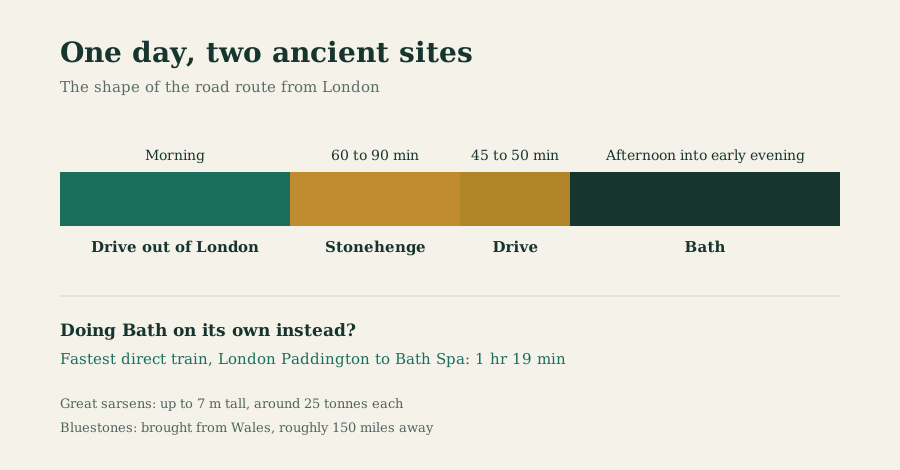
Here is the problem nobody tells you up front. Stonehenge is not near a station. It sits on Salisbury Plain in Wiltshire, and the nearest town with a proper rail link is Salisbury, then you still need a bus or taxi out to the stones. Bath is roughly 45 to 50 minutes' drive from Stonehenge by car, but there is no direct, sensible public route that hops you straight from one to the other. By train and bus you would go back and forth through junctions, burning most of your daylight on platforms. I tried to build that itinerary and gave up twice.
So this post is really two answers to one question. Yes, you can see both in a day. No, you probably should not attempt it by public transport unless you enjoy logistics as a hobby.
What is Stonehenge actually like when you get there?
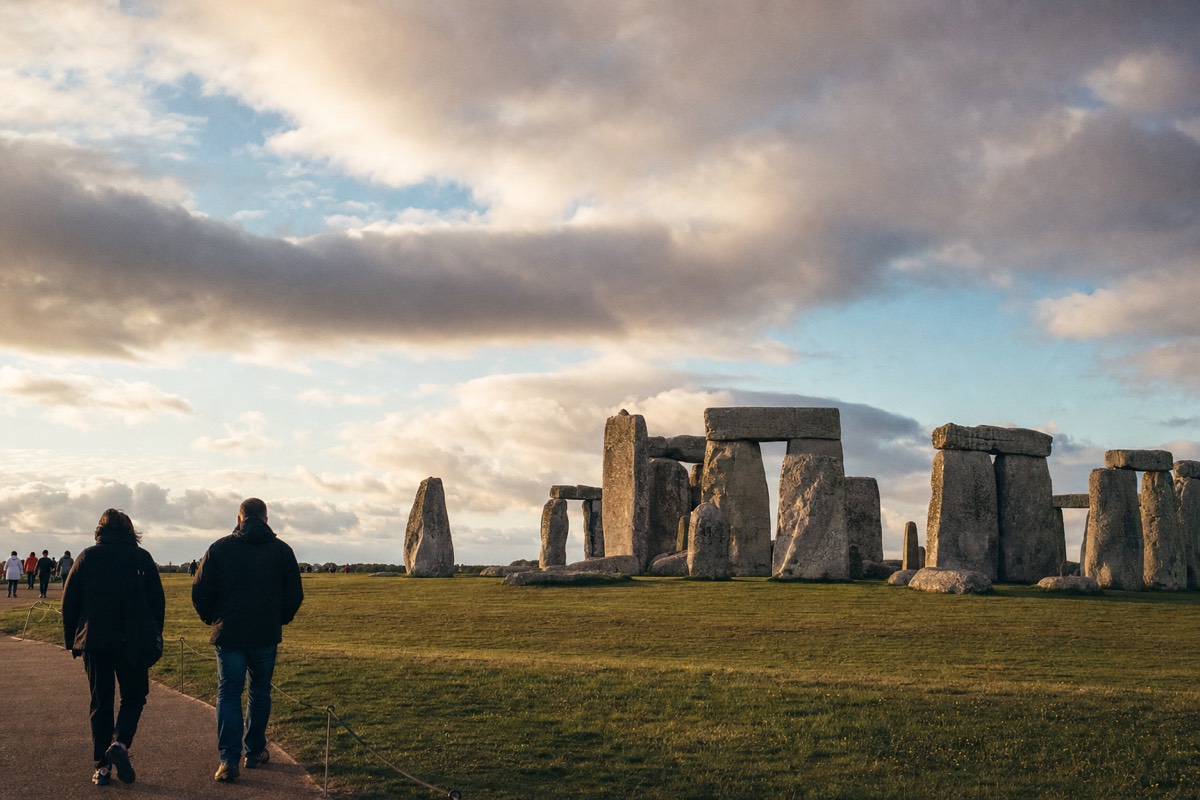
Windswept, roped off, and stranger than the photos suggest. A shuttle runs you out from the visitor centre, then you circle the stones on a marked path in about 40 minutes. The great sarsens stand up to 7 metres tall and weigh around 25 tonnes each. Allow an hour to ninety minutes in total.
I had braced myself for disappointment. Everyone warns you the stones are "smaller than you think" and that you cannot walk up and touch them, both of which are true. What I did not expect was how the site works on you anyway.
You approach from the visitor centre, which sits a mile or so from the circle, and a shuttle runs you out across the plain. Then the stones just appear, standing alone in a huge open sweep of grass with the wind doing whatever it wants. These are prehistoric, older than the Romans by thousands of years, and standing there you get a strange, quiet sense of deep time that a photo never carries. I walked the roped path around the circle slowly. It took maybe 40 minutes with stops, and I was glad I did not rush it.
The audio guide is worth grabbing. It fills in the theories about how the stones got there and why, and it is honest that a lot remains guesswork. English Heritage's Stonehenge pages carry the current opening times and prices, which shift through the year, so check before you lock in a slot.
| Stonehenge fact | The number |
|---|---|
| Great sarsen stones | Up to about 7 m tall and around 25 tonnes each |
| Bluestones | Hauled from Wales, roughly 150 miles away |
| Visitors | Around a million people a year |
| Time on site | An hour to ninety minutes, shuttle included |
| Onward drive to Bath | About 45 to 50 minutes |
What does Bath give you in the same afternoon?
An afternoon covers the essentials well. The Roman Baths anchor it with about ninety minutes, then Bath Abbey stands right outside the exit, Pulteney Bridge is two minutes further, and the Royal Crescent a ten minute uphill walk. The whole centre is compact, golden and walkable, a UNESCO listed city you can cross on foot.
Bath is the opposite kind of place, and that contrast is exactly why the pairing works so well. Where Stonehenge is bare and windswept, Bath is dense, warm and golden, a whole city built from honey-coloured stone and packed into a river valley. The entire city is a UNESCO World Heritage Site, which is rare for anywhere, let alone somewhere this compact.
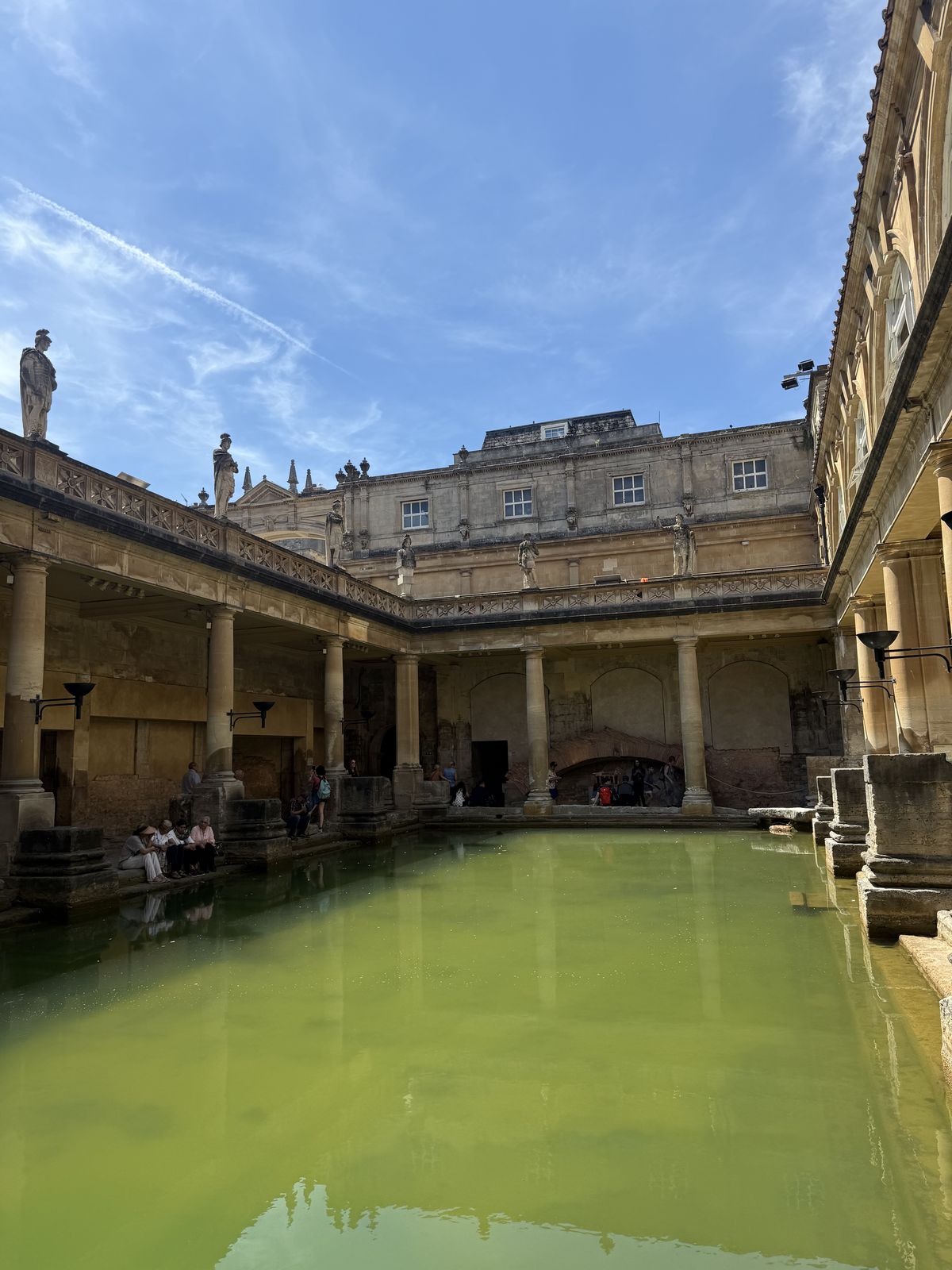
If you only have an afternoon, the Roman Baths are the anchor. The Romans built the complex around Britain's only naturally hot spring, and the water still surfaces steaming at around 46°C. You walk terraces above the Great Bath, which glows an odd green because it is open to the sky and algae grows in the sunlight. You cannot touch or bathe in the water here, which surprises people, but the museum around it holds the gilded bronze head of Sulis Minerva and a carved Temple pediment with a fierce Gorgon's face. Allow about an hour and a half. One track of the audio guide is voiced by Bill Bryson, which made me smile.
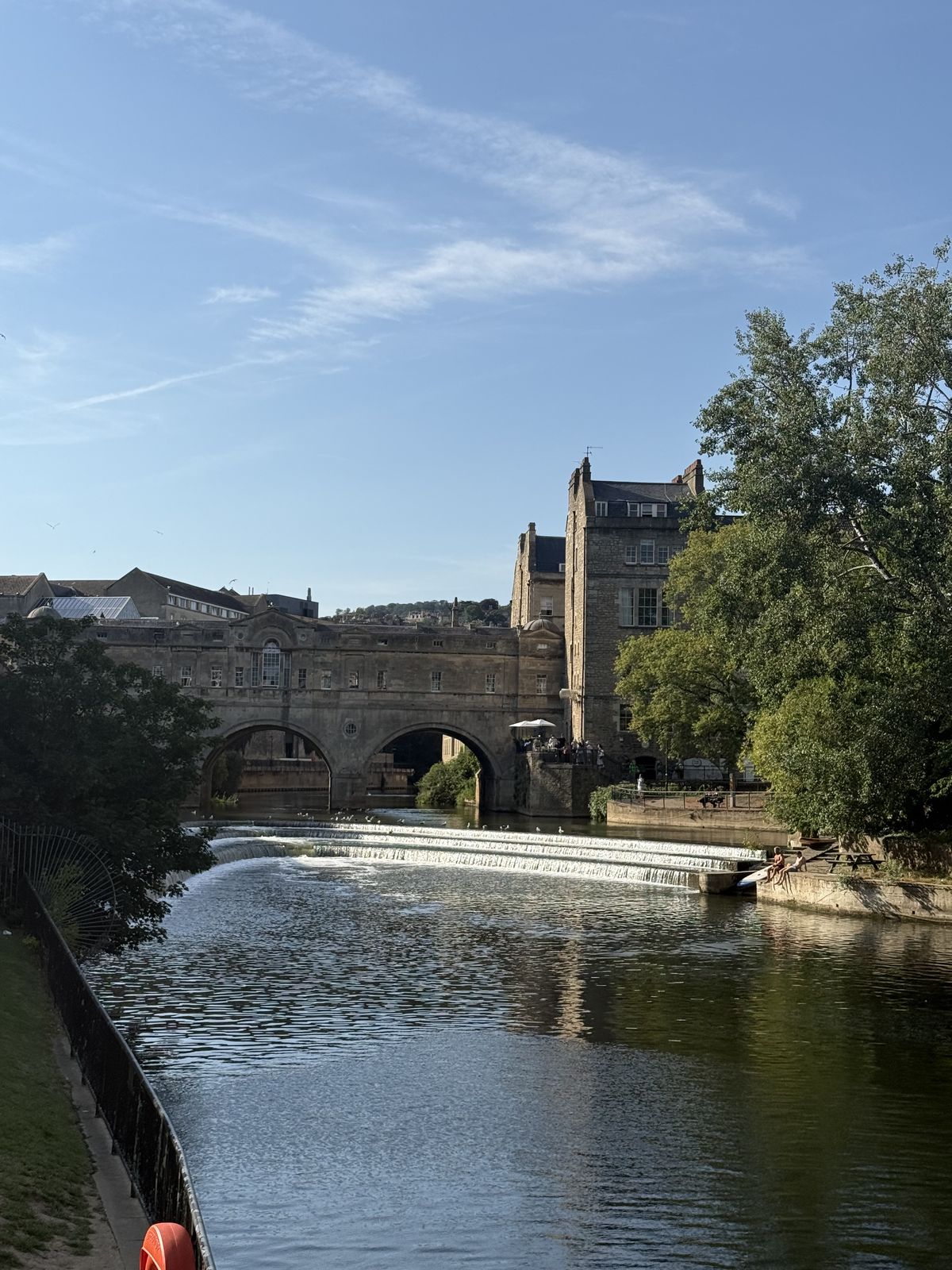
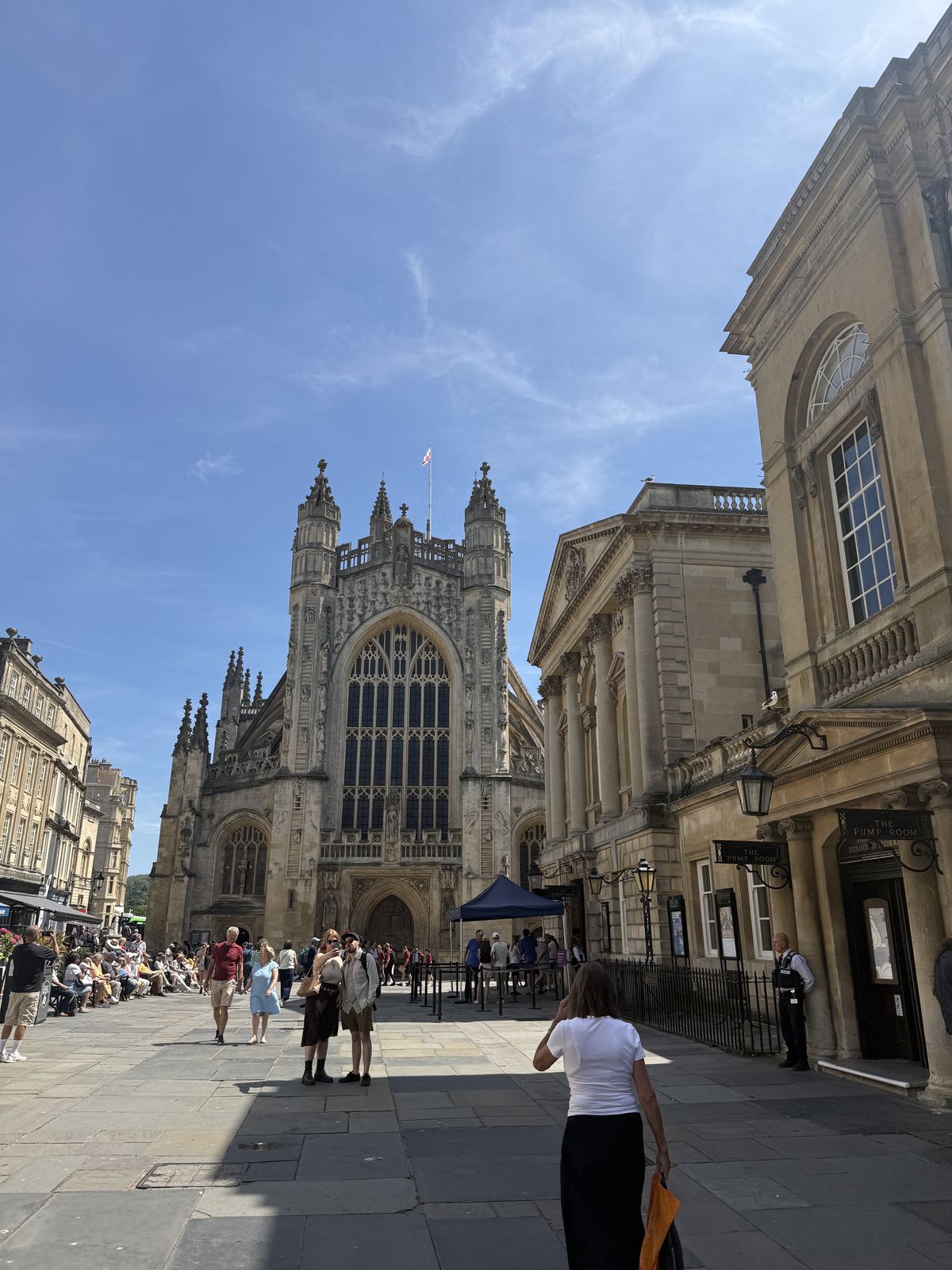
Step outside and Bath Abbey is right there, its west front carved with stone angels climbing ladders toward heaven. Two minutes further you reach Pulteney Bridge, one of the very few bridges anywhere with shops running the full length of both sides, and below it the river spills over a curved horseshoe weir. If you still have energy, the Royal Crescent is a ten-minute uphill walk, thirty grand townhouses sweeping in one long curve. On a tight afternoon I would do the Baths, the Abbey, the bridge, and a slow wander through the Georgian lanes, then call it a good day.
| Stop | Getting there | What you get |
|---|---|---|
| Roman Baths | The anchor, book a timed slot | Great Bath terraces, Sulis Minerva's gilded head, the Gorgon pediment |
| Bath Abbey | Right outside the Baths | Angels climbing stone ladders up the west front |
| Pulteney Bridge | Two minutes further | Shops along both sides, the horseshoe weir below |
| Royal Crescent | Ten minutes uphill | Thirty townhouses in one long Georgian curve |
Should you book a tour or piece the day together yourself?
Take the train if Bath alone is the goal: it is direct, fast and drops you five minutes from the Roman Baths. The moment Stonehenge joins the plan, book a guided tour instead. The stones have no rail link, the cross country hop is a car journey, and a driver who owns the route saves the day.
Here is roughly how the day shakes out on a guided route that does both. You leave London in the morning, drive out to Stonehenge for the first slot, spend your ninety minutes there, then cut across country to Bath for the afternoon and early evening before heading back. Some tours slot in a third stop, often Windsor Castle on the way out or the village of Lacock, which is worth knowing so you can pick the shape you want.
| Way to run it | How the day works | The catch |
|---|---|---|
| Guided tour by road | London out in the morning, about ninety minutes at the stones, cross country to Bath for the afternoon | You move on the group's clock |
| DIY by rail and bus | Paddington to Salisbury, the Stonehenge bus out and back, then doubling back toward Bath | Most of your daylight goes to platforms |
| Bath only by train | Direct from Paddington in as little as 1 hour 19 minutes, station five minutes from the Baths | No Stonehenge at all |
By train the maths is unforgiving. London Paddington to Bath Spa direct takes as little as 1 hour 19 minutes on GWR, which is genuinely quick and easy on its own. Stonehenge is the spanner. To bolt it on you would need Salisbury, then the dedicated Stonehenge bus, then double back, and you would be watching the clock the entire time. If Stonehenge is a must, the car route is the sane one.
I will be straight about this. If Bath alone is your goal, skip the tour and take the train. It is fast, and you keep full control of your day. My guide on how to get from London to Bath breaks the options down, and how far Bath is from London covers the distances if you are weighing it up.
But the moment you want Stonehenge in the same day, the calculus flips. This is exactly where a guided day tour to Bath earns its keep: someone else drives, times the stops, and handles the Stonehenge entry, so you spend your energy looking at things rather than at timetables. I will not quote you a price here because it moves around; the live cost sits on the operator's listing.
A few honest tips before you commit. Book the Roman Baths as a timed ticket in advance, especially in summer, when walk-up slots vanish. Check the official Roman Baths website for the current price and to reserve. Wear real shoes, because Bath is hilly and the stone underfoot at both sites gets slippery in the wet. And do not over-pack the day: two headline sights done properly beat three done in a blur.
Would I do it again? For a first visit that wants the "ancient Britain" bucket list and a beautiful city in one hit, yes, gladly, as long as I let a driver own the route. If you have a second day, though, give Bath its own, because there is far more to it than an afternoon allows.
Plan your next step
Stonehenge & Bath from London
Have a travel date in mind? See Stonehenge and Bath with the coach journey and guide arranged together. Check your date before arranging the rest of your day.
About 11 hours; Victoria Coach Station departure, Gloucester Road return. Choose the admission option you want; meals and hotel pickup are not included.
Start with this option, or compare the choices below.
Choose a date to see the published schedule.
Compare the options for your Bath plans
| Experience | Why choose it | Allow | What to account for |
|---|---|---|---|
| Stonehenge & Bath from London | See Stonehenge and Bath with the coach journey and guide arranged together. | 11 hours | About 11 hours; Victoria Coach Station departure, Gloucester Road return. Choose the admission option you want; meals and hotel pickup are not included. |
| Castle Combe, Stonehenge & Bath from London | Combine a Castle Combe stop with time in Bath and Stonehenge on one small-group day. | 11.5 hours | About 11½ hours from London. Stonehenge admission costs extra; Roman Baths entry and meals are not included. Minimum age 3. |
| City walk & Roman Baths entry | Pair a Blue Badge guided city walk with a self-guided visit inside the Roman Baths. | 3 hours | About 3 hours; meet outside Bath Abbey’s main doors. Roman Baths entry and audio guide included; your guide does not lead the visit inside. |